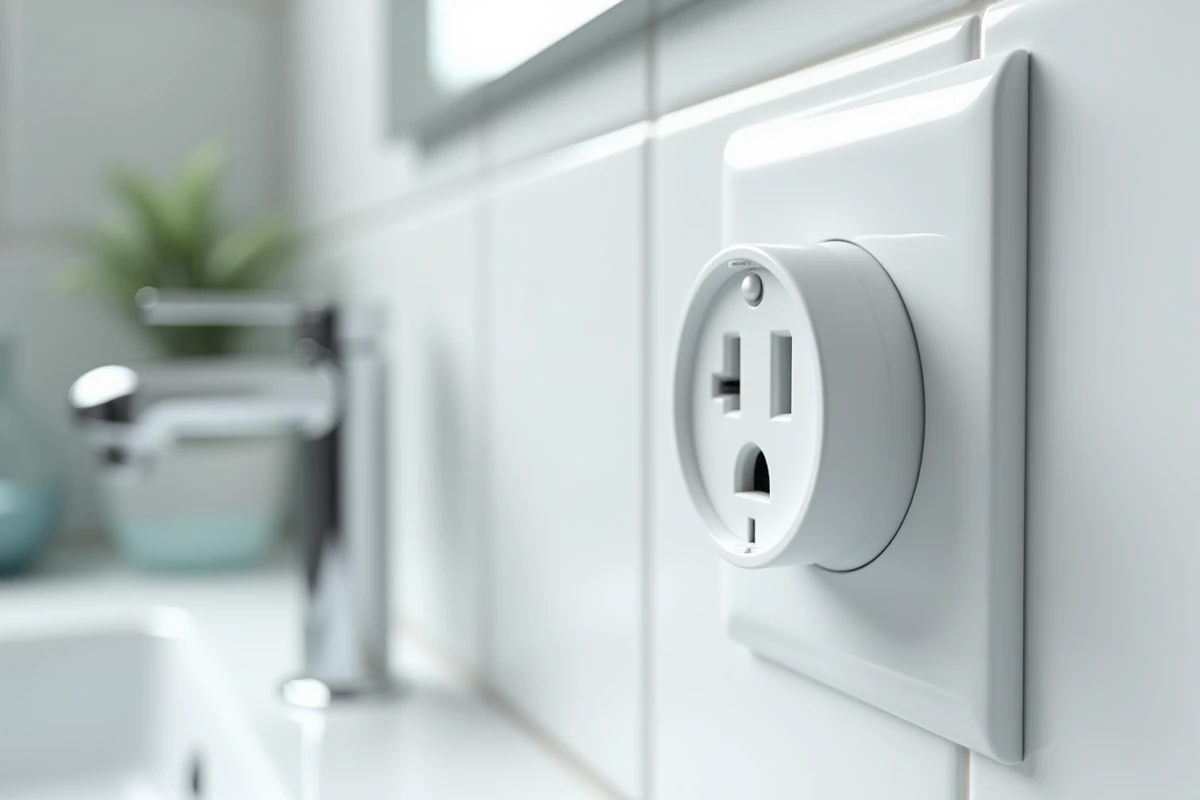
Plugging in a hairdryer near the sink, charging an electric toothbrush next to the shower: these everyday actions assume an electrical installation designed to withstand moisture. The NF C 15-100 standard precisely regulates the location and type of outlets allowed in a bathroom. Understanding these rules helps avoid a real risk of electrocution and ensures the compliance of your home.
IP protection rating and electrical class: what the markings really mean
Before discussing distances or volumes, it’s essential to know how to read the markings on electrical equipment. Have you ever noticed the inscriptions “IP44” or “IPX7” on a light fixture or an outlet? These two numbers indicate the device’s resistance to solid objects (first digit) and water (second digit).
The higher the second digit, the more the device can withstand prolonged or intense contact with water. A device marked IPX4 resists splashes, while an IPX7 tolerates temporary immersion. In a bathroom, the choice of the IP rating directly depends on the area where the device will be installed.
The protection class relates to the electrical insulation of the device. A class II device has double insulation and does not require a ground connection. This is the preferred type for areas close to water. A class I device, connected to ground, is suitable for areas further away from water points.
These two systems (IP and class) combine: the NF C 15-100 standard specifies, volume by volume, which IP rating and class are required. Without this cross-reading, choosing the right equipment is a matter of chance. The Toute La Maison guide on bathrooms details these combined requirements for each area.

NF C 15-100 safety volumes: where to place an outlet in the bathroom
The standard divides the bathroom into concentric zones around the bathtub or shower tray. Each zone, called a “volume,” imposes increasing restrictions as one gets closer to the water.
Volume 0: the inside of the bathtub or shower tray
This is the area of direct contact with water. No electrical outlets are allowed here. Only equipment powered by very low safety voltage (TBTS) of 12 V maximum can be installed, with a minimum IPX7 rating.
Volume 1: above the bathtub or shower
This zone extends vertically above volume 0, up to a height defined by the standard. Power outlets are prohibited here. An instantaneous water heater or a light fixture can be installed, provided they are powered by TBTS 12 V and protected with at least IPX4 (IPX5 if the bathroom is a communal space with jets).
Volume 2: the buffer zone
Volume 2 extends around volume 1. Class II devices are allowed here, with a minimum IPX4 rating. Standard power outlets remain prohibited, except for outlets powered by TBTS or isolated shaver sockets with a separation transformer.
Outside volume: the only area where a standard outlet can be placed
Beyond volume 2 is the “outside volume.” It is here, and only here, that a standard power outlet can be installed. This area generally starts more than 60 cm from the edge of the bathtub or shower tray.
A detail often overlooked: if your bathroom is small, there may simply be no outside volume. In this case, no standard power outlet can be installed in the room.
30 mA differential protection and equipotential bonding: two devices not to be confused
The volumes define where to place the equipment. Differential protection and equipotential bonding determine how the circuit reacts in case of a fault.
The 30 mA differential circuit breaker continuously monitors the balance of current between the phase and neutral. As soon as a current leak exceeds 30 milliamperes (for example, a current passing through the human body via water), it cuts off the power in a fraction of a second. The NF C 15-100 standard requires that all circuits supplying the bathroom be protected by this type of device.
Why 30 mA and not less? Because it is the threshold below which the leakage current is considered potentially lethal for an adult. This is not a comfort margin; it is a physiological threshold.
The additional equipotential bonding connects all metallic elements in the bathroom: water pipes, drainage, metal bathtub body, metal door frames. Its role is to prevent a potential difference from appearing between two elements that you might touch simultaneously. Without this bonding, a fault on a pipe could create an electric shock via the plumbing fixtures.
- The 30 mA differential protects against current leaks to the ground by automatically cutting the circuit.
- The additional equipotential bonding prevents voltage differences between accessible metallic elements.
- Both devices are mandatory and complementary: one does not replace the other.

Special case of the sink outside the bathroom and common renovation mistakes
A sink installed in a bedroom or hallway is not subject to the same volumes as a sink located in a closed bathroom. The NF C 15-100 standard provides for reduced volumes around an isolated sink, allowing an outlet to be closer to the water point than in a full bathroom.
In renovations, the most common mistake is moving a shower or bathtub without recalculating the volumes. A tray shifted by a few dozen centimeters can move an existing outlet from “outside volume” to volume 2, making it non-compliant. Any movement of a water point requires redrawing the volumes and checking each existing electrical equipment.
Another pitfall: fixed glass shower walls. Depending on their height and attachment, they can alter the layout of volumes 1 and 2. A fixed wall from floor to ceiling reduces the extent of volume 1 on the room side, while a simple low shower screen does not change the calculation.
- Always recalculate the volumes after any movement of a bathtub, shower, or tray.
- Check if a fixed shower wall alters the layout of the volumes (height and attachment to the floor and ceiling).
- Have the installation checked by a qualified professional after renovation work affecting plumbing or electricity.
The electrical compliance of a bathroom is not verified just once during construction. Any modification, even minor, to the positioning of a water point or partition re-evaluates the layout of the volumes and the validity of the existing installation.