
Only a civil registrar can celebrate a civil marriage in France. This authority, governed by the Civil Code, cannot be freely delegated to any municipal agent or a relative of the spouses. Understanding who truly holds this power helps avoid mistakes that could undermine the validity of the union.
Delegation of the celebration: the limits imposed by the Civil Code on the civil registrar

The mayor is the civil registrar by law. He can delegate the celebration of the marriage to his deputies and, under certain conditions, to municipal councilors. The delegation takes the form of a nominative municipal decree. Without this decree, a municipal councilor cannot validly celebrate the union.
An administrative agent of the town hall, even if he prepares the file and summons the future spouses, has no authority to preside over the ceremony. Confusion is common in small municipalities where versatile staff manage reception and civil status. We observe that couples sometimes discover on the day of the ceremony that the person they thought would be the officiant has not received formal delegation.
This delegation is only valid within the territory of the municipality. A delegated deputy in Bordeaux cannot celebrate a marriage in Lyon, even if the spouses reside there. Territorial competence remains a foundation of French civil status law.
The question of who can celebrate a civil marriage is therefore resolved by a precise mechanism of delegation, not by a simple verbal agreement from the mayor.
Reading of the marriage certificate: legal obligations and scope for adaptation
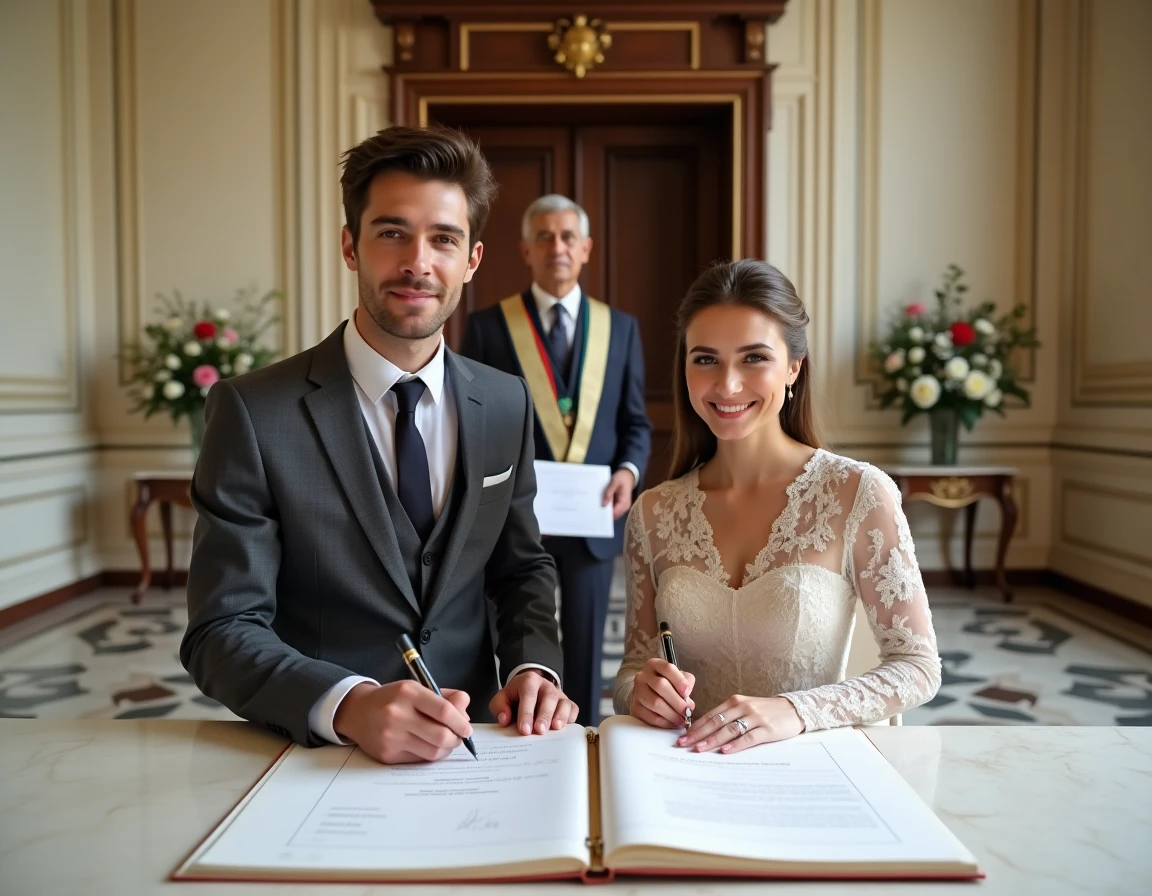
The civil registrar must read to the spouses the articles of the Civil Code relating to the rights and duties of spouses. This reading particularly covers the obligations of respect, fidelity, mutual assistance, and support. It constitutes a substantial formality: its omission can be invoked in the context of a dispute over the validity of the marriage.
In practice, the reading is not always verbatim. Professional guides for civil registrars specify that the ceremony can be adapted, provided that the legally required mentions are effectively communicated to the spouses. The officiant can rephrase, comment, and contextualize, as long as no legal provision is omitted.
After reading the articles, the officiant collects the consent of each spouse, then pronounces the union in the name of the law. He then proceeds to read the actual marriage certificate, which mentions the first names, last names, dates, and places of birth of the spouses, as well as the chosen marital regime. This document is signed on-site by the spouses, witnesses, and the officiant.
Marriage certificate and family record book
The marriage certificate is recorded in the civil status registers of the municipality where the ceremony took place. A family record book is given to the spouses at the end of the ceremony. This book is not just a keepsake: it is an official document certifying the union and serving as a basis for subsequent administrative procedures.
Interpreter and language of the ceremony: an obligation linked to consent
The ceremony is conducted in French. The civil registrar pronounces the official formulas and reads the articles of the Civil Code in this language. Civil status acts must be written in French, in accordance with an obligation dating back to the law of 2 Thermidor Year II.
When one of the future spouses does not understand French, the presence of an interpreter becomes a legal obligation, not just a convenience. The interpreter translates the formulas and articles read, as well as the questions posed to the spouses. This requirement aims to ensure that the consent given is free and informed.
- The interpreter must be of legal age and not part of the witnesses to the marriage.
- They can be chosen by the spouses or appointed by the civil registrar.
- Their identity is mentioned in the marriage certificate.
Recent parliamentary questions have addressed the possibility of celebrating all or part of the ceremony in a regional language. Under current law, the officiant can add elements in another language, but the official formulas remain in French.
Witnesses of the civil marriage: legal role during the reading of the act
The civil marriage requires the presence of at least two witnesses. Their role is not limited to passively attending the ceremony. They attest to the reality of the exchange of consents and sign the marriage certificate alongside the spouses and the officiant.
- The witnesses must be of legal age and enjoy their civil rights.
- They can be family members of the spouses or not, with no restriction on the relationship.
- A maximum of four witnesses is allowed (two per spouse).
The witnesses do not read the marriage certificate and do not pronounce any formulas. This prerogative belongs exclusively to the civil registrar. Assigning a reading to a witness or a relative falls under the secular ceremony, distinct from the official civil marriage.
Distinction between civil ceremony and secular ceremony
The confusion between these two formats is common. The secular ceremony, often organized after the civil ceremony at the town hall, allows relatives to read texts, personal vows, or literary excerpts. It has no legal value. Only the civil ceremony, presided over by the civil registrar in the town hall (or, in case of serious impediment, at one of the spouses’ homes), produces legal effects.
The civil marriage remains an act of public authority. The publication of the banns, the verification of the documents in the file, the reading of the articles of the Civil Code, and the collection of consent form a sequence, each step of which falls under the competence of the civil registrar or his duly authorized delegate. Anyone who would celebrate a marriage without this authority would be subject to criminal sanctions.