
A T2 represents the most sought-after housing format in the French rental market. For a couple, this configuration (one closed bedroom, a living room, a kitchen, and a bathroom) seems tailor-made. The daily reality is more nuanced, especially when remote work comes into play or when a child is planned in the medium term.
Remote work for two in a T2: the real sorting criterion
Since the widespread adoption of hybrid work, couples in T2s identify the main source of friction as the difficulty of working remotely at the same time in the same space. The issue is not the total area, but the lack of a second closed or semi-closed space.
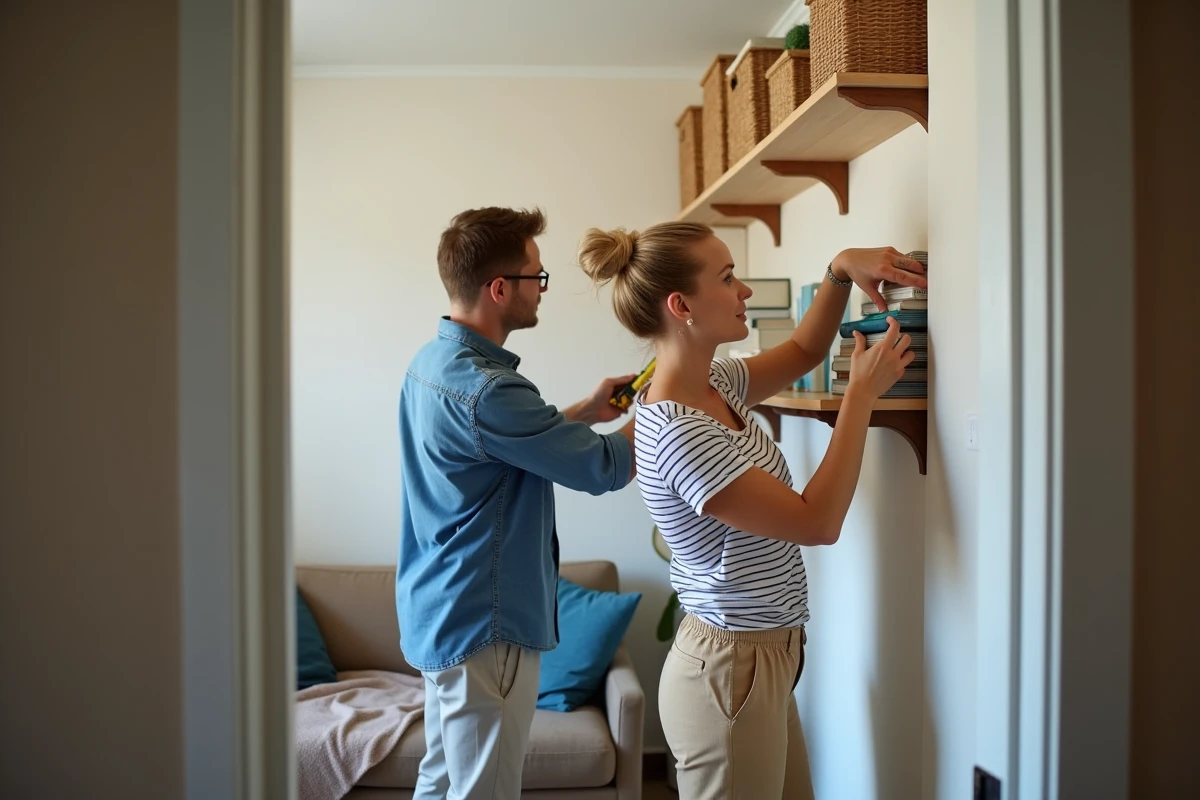
A T2 where the living room allows for a distinct office corner, visually separated from the sofa by a shelf or a movable partition, radically changes the situation. Feedback from managers of residences for young professionals confirms this point: cohabitation works significantly better when the living area allows for two simultaneous uses, work and relaxation.
Before signing a lease, one should mentally test a concrete scenario: two video conferences at the same time, on a rainy Tuesday afternoon. If the living room cannot accommodate this constraint, the housing will be a source of tension within six months. The choice to live together in a T2 largely depends on this ability to double the uses in a limited space.
T2s with a balcony or loggia have a concrete advantage here: this extension, even modest, offers a retreat for making a call or simply isolating oneself for a few minutes.
Area and configuration of the T2: what matters beyond square meters
The mention of “T2” in a real estate listing does not guarantee a uniform level of comfort. Two T2s of identical size can offer radically different living experiences depending on the layout of the rooms.
Here are the configuration elements that weigh most on a couple’s comfort:
- The physical separation between the bedroom and living room: a solid door reduces noise disturbances when one sleeps and the other stays awake, a detail that becomes structuring over the months
- The presence of an entry space or hallway: without a vestibule, the living room absorbs all the flows (shoes, coats, groceries), visually saturating the living area
- The closed or open kitchen: an open kitchen visually enlarges the living room but spreads odors and noise, a trade-off to be made depending on the couple’s lifestyle
- The volume of integrated storage (closets, dressing rooms): in a T2, every square meter of storage prevents cluttering the living areas with additional furniture
The L-shaped configuration of the living room, when it exists, allows for a natural separation between a dining area and a relaxation space. This is a rare asset in recent T2s, often designed in a strict rectangle.
Lease and couple status: legal implications to anticipate
The legal status of the couple directly influences the rights related to housing. A married couple, civil partnership, or cohabiting couple does not benefit from the same protections regarding the rental lease.
Having two names on the lease protects each occupant in case of separation. If only one member of the couple signs, the other has no right to remain in the property if the tenant leaves. For unmarried and unpartnered couples, this precaution is the only solid legal guarantee.
In the event of separation, the tenant whose name is on the lease retains the housing. The other must leave, even if they have contributed to the rent for years. This point generates frequent conflicts that few couples anticipate at the time of signing.
Solidarity clause in the lease
When both names are on the lease, a solidarity clause generally applies. This means that the landlord can demand the full rent from either tenant, even after one of them departs. This solidarity lasts for six months after the departing tenant’s notice, unless stated otherwise.
A couple considering taking a T2 together should read this clause before signing and negotiate its duration with the landlord if possible.
Realistic lifespan of a couple in a T2
The available data on rental turnover shows a recurring pattern: a couple in a T2 stays on average significantly longer than a single tenant in a studio. Financial stability for two (sharing rent, expenses) and the superior comfort compared to a studio explain this extended stay duration.
However, the arrival of a child almost systematically triggers a move to a T3. The T2 serves as a transitional housing for the couple, between the individual studio and the first family apartment.
This cycle has concrete implications for those considering buying their T2 rather than renting it. If the expected holding period is short (less than five years), notary fees and potential renovations may not be recouped upon resale. The question of furnished or unfurnished also arises differently depending on whether one plans to keep the property as a rental investment after moving out.
When the T2 remains the right choice for the long term
For couples without plans for children, blended families with shared custody, or young retirees downsizing, the T2 is not a transitional housing. It becomes a sustainable choice, provided the configuration allows each person to maintain a minimum of personal space.
The issue is not the size of the housing but the compatibility between the couple’s lifestyle and the layout of the chosen T2. A well-distributed apartment in a quiet residence, close to transport and shops, remains a satisfactory living environment for two people over several years. The main constraint remains that of storage space, which often proves to be undersized after the first year of shared living.