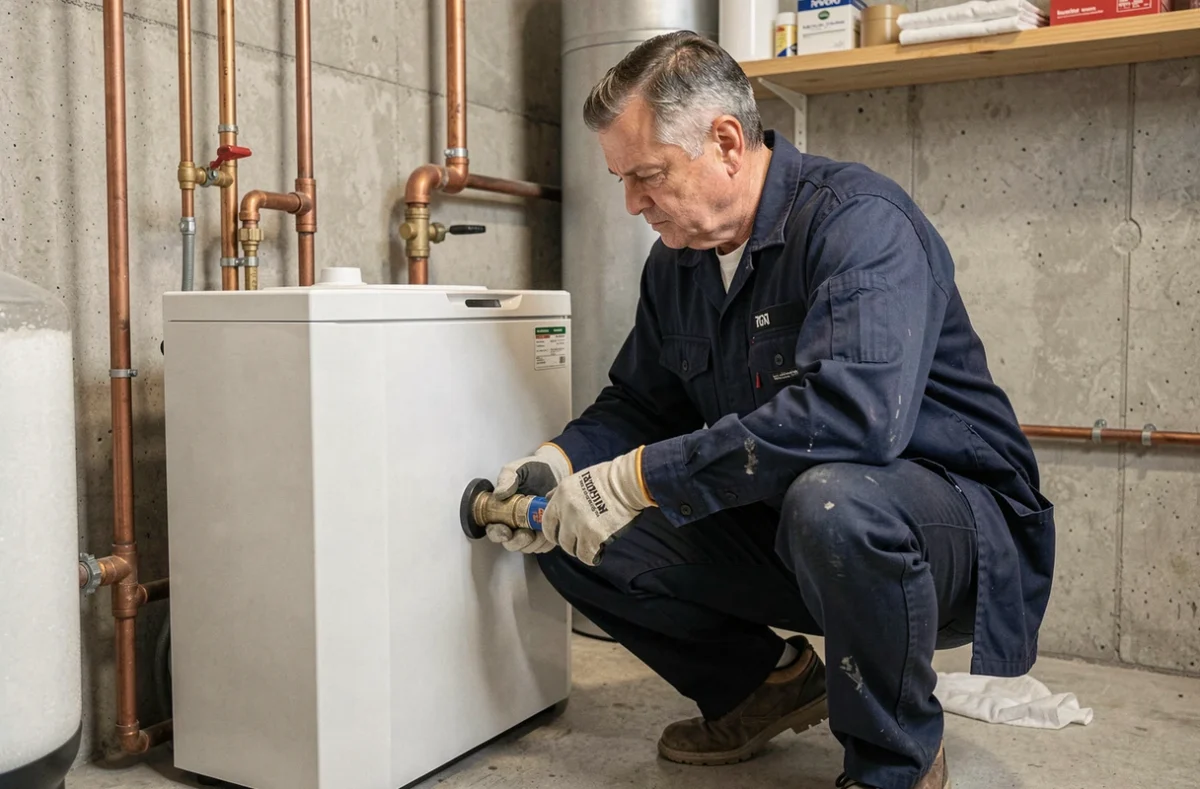
A water softener that is not functioning properly does not always provide obvious warnings. The water gradually becomes hard again, the salt disappears too quickly or not at all, and an odor appears for no clear reason. Before contacting a technician, several checks can help identify the cause of the problem and, in some cases, resolve it yourself.
Abnormal salt consumption: what the brine tank really reveals
The salt level in the tank is the first indicator of the state of a water softener. Two opposing situations deserve attention, and each points to different causes.
When the salt no longer descends, three hypotheses stand out. The most common is a salt bridge: a hard crust forms on the surface of the tank, creating an empty space between the salt and the water below. The device then draws in unsaturated water, and the regeneration fails.
Sometimes, simply breaking this crust with a wooden handle is enough to restore functionality. Other possible causes include a regeneration that does not trigger (programming or flow meter issue) or a brine suction defect (clogged injector, obstructed circuit).
Conversely, excessive salt consumption often signals a regeneration stuck in a loop, a faulty flow meter, an internal leak, or a poor setting of residual hardness. Before intervening on the electronics, it is useful to discover AKOITIQUE’s tips to distinguish a mechanical problem from a setting issue.
The by-pass as a diagnostic tool for a water softener
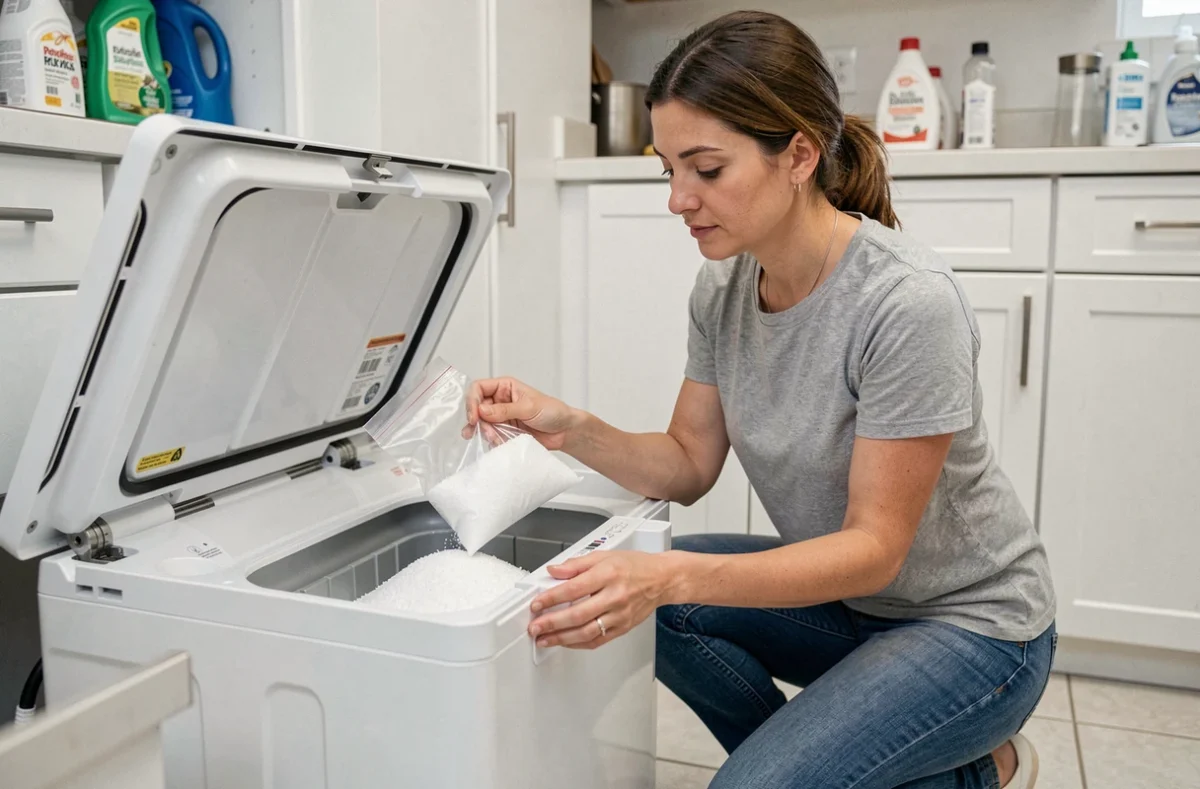
The by-pass valve is not just a safety position for installation or maintenance. It is a true diagnostic tool that few users take advantage of.
The principle is simple: by switching to the by-pass, water flows directly into the network without passing through the resin. If the observed problem (salty taste, odor, discoloration) disappears, the softener is at fault. If it persists, the problem comes from the upstream network.
Several situations justify immediately switching to by-pass:
- Water with a salty taste, indicating that the brine is not properly rinsed after regeneration or that the control valve is malfunctioning
- An unusual odor or discoloration of the treated water, which may indicate bacterial growth in the tank or resin
- A regeneration that seems to run continuously, with a constant draining noise
- A visible leak at the valve head or fittings
Switching to by-pass suspends the use of treated water while waiting for a check of the device, without cutting off the household water supply. This is the first step to take in response to abnormal behavior.
Setting residual hardness: the trap of “as soft as possible”
A common reflex is to set the softener to its maximum potential, aiming for the lowest possible residual hardness. This choice seems logical, but it poses several concrete problems.
Excessively softened water increases salt consumption and the volume of regeneration water without proportional benefits for pipes or appliances. The extra cost in salt and discharged water accumulates over the year without the user realizing it.
Monitoring the TH (hydro-timetric title) at the output of the softener should aim for a balance: low enough to prevent limescale buildup, high enough to avoid wasting resources. The measurement is done with strips or a test kit, available at hardware stores. In practice, checking the TH at the output allows for adjusting the hardness setting and avoiding excessive treatment as well as a return of limescale.
If the measured TH does not correspond to the setting displayed on the valve, the problem may come from saturated resin, a poorly calibrated regeneration volume, or a flow meter that does not trigger at the right time.
Water softener after a prolonged absence: the restart procedure
This aspect is rarely addressed and yet is the source of many service calls. A volumetric softener generally does not regenerate when no water is consumed. After several weeks of absence (vacation, secondary residence), water has stagnated in the resin and pipes.
The restart procedure depends on the model, but some steps remain common:
- Consult the manual to check if a manual regeneration needs to be initiated before any use
- Run cold water then hot water at each water point in the home, faucet by faucet, for several minutes
- Check the salt level and the absence of a salt bridge in the brine tank
- Consider disinfecting the resin if the absence has exceeded several weeks, according to the manufacturer’s recommendations
The ARS Grand Est recommends running cold then hot water at each water point after a prolonged absence. This rinsing step applies to the entire household network, not just the softener.
Disinfecting the resin: when and how to intervene
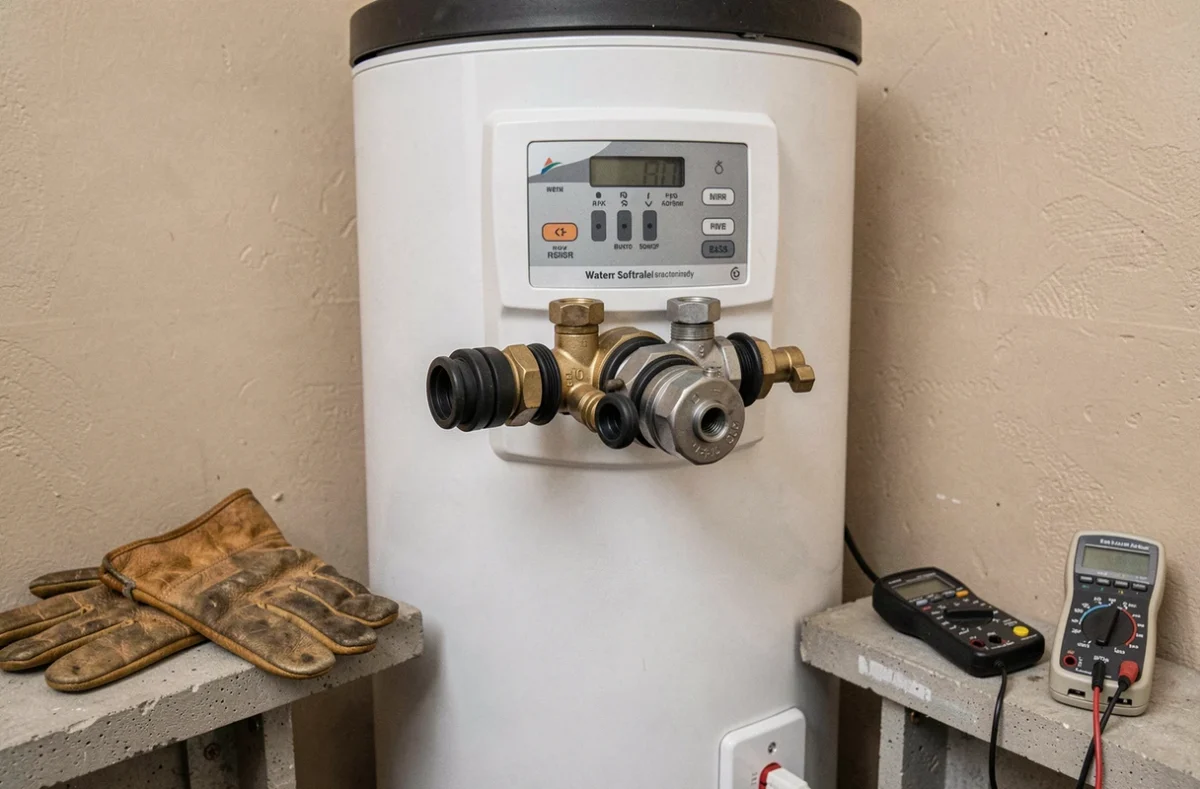
The ion-exchange resin is the heart of the softener. It retains calcium and magnesium ions to replace them with sodium ions. Over time, this resin can become a favorable environment for bacterial growth, especially if the device remains inactive or if the feed water contains organic matter.
Disinfecting the resin does not replace salt regeneration: these are two distinct operations. Regeneration restores the ion-exchange capacity, while disinfection eliminates microorganisms. Specific disinfectant products for softener resins exist and are used according to a protocol specific to each manufacturer.
Field reports vary on the ideal frequency of disinfection. Some manufacturers recommend it once a year, others only after a period of inactivity or in case of a suspicious odor. In doubt, referring to the technical documentation of the installed model remains the most reliable approach.
A well-maintained softener does not require heavy interventions. Most breakdowns stem from a lack of salt monitoring, an unreviewed setting, or a lack of rinsing after inactivity. Three simple control points that prevent most service calls.