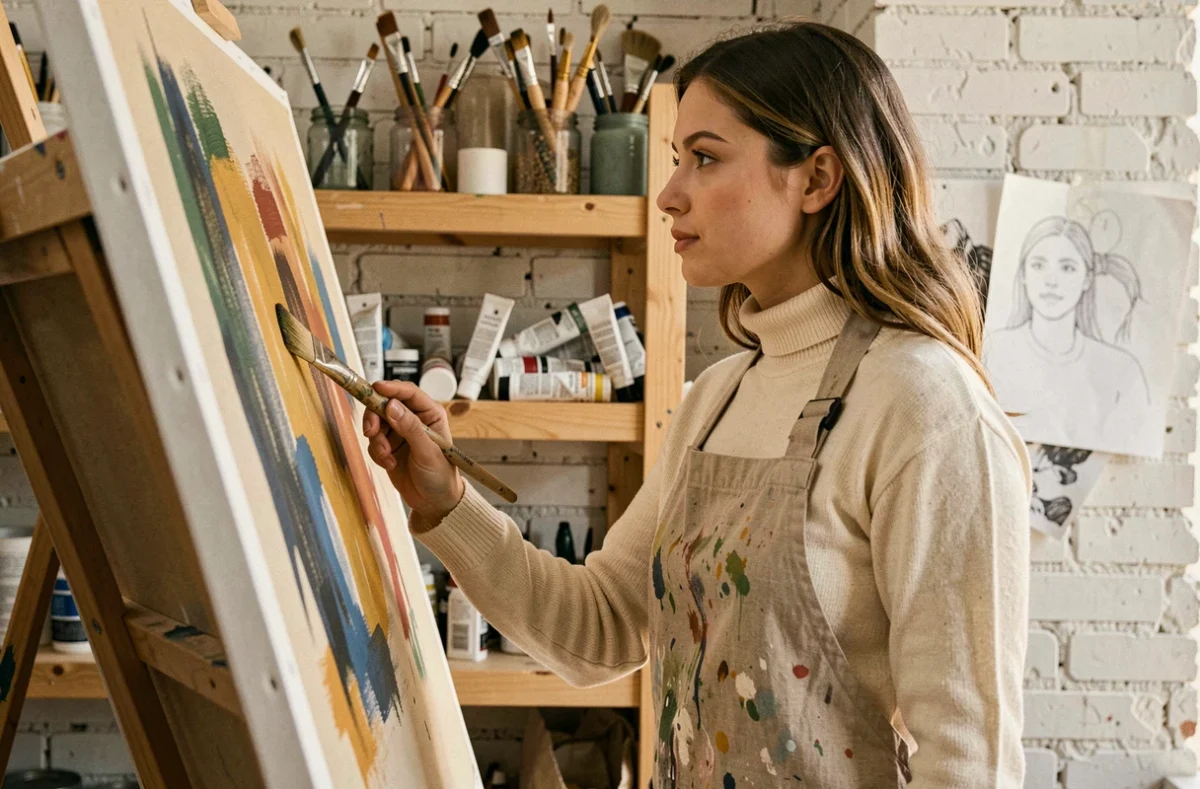
Astrée Lhermitte-Soka is a French visual artist whose work primarily unfolds in painting, organized into long-term thematic series. Trained in graphic design and illustration at the Savannah College of Art and Design in Georgia, she held various visual jobs before dedicating herself to canvas.
From graphic design to cinema: the jobs preceding painting
Astrée Lhermitte-Soka’s journey does not begin in front of an easel. After her studies in the United States, she worked as a graphic designer in New York for several years. This first professional life gave her a mastery of composition, framing, and typography that still informs her canvases.
She then shifted to cinema, not in front of the camera, but behind the scenes. Her work as a makeup artist imposed a physical relationship with color, the modeling of faces, and artificial light. These technical skills, rarely mentioned in profiles that focus on her lineage, form the concrete foundation of her painting practice.
To better understand this unique trajectory, Astrée Lhermitte’s journey on Véron outlines the stages of her career and her achievements.

Astrée Lhermitte’s thematic series: a painting structured by language
What distinguishes Astrée Lhermitte-Soka’s work from many contemporary painters is the organization of her production into coherent thematic series rather than isolated works. Each set is based on a narrative thread where text and title play a full role.
Among the documented series are Doux-sœur, Les robes porte-bonheur, and Hexagone exigu. The titles are not decorative. They evoke memory, emotional ties, language, and the question of belonging. The painted word accompanies the image, sometimes contradicting it.
Otom Potom: a series started in 2009 and still ongoing
The Otom Potom series exemplifies this long-term method. Its title borrows a difficult-to-translate Serbo-Croatian expression, both playful and enigmatic. Art critic Axelle Corty, who commented on this series, describes a painting that “plays with words and pains” and “speaks of life and its wounds.”
Works like Les quatre coings d’un monde or Treize lunes et autant de savonnettes à l’iréos blend literary references (Cesare Pavese in particular) and wordplay. Other titles, La Semaine des quatre jeudis or La Mie de la boulangère, function as small exorcisms in the face of existential vertigo, according to the critic’s terms.
This continuity over more than a decade sets Astrée Lhermitte-Soka apart from artists who jump from one project to another without a guiding thread.
Digital distribution and autonomy: the choice of an emerging artist
Astrée Lhermitte-Soka favors a largely direct distribution. Her personal website serves as a portfolio where each series is presented with mediation texts. No representation by a heavily publicized gallery appears in the available sources.
This model relies on several concrete elements:
- A site that combines visuals of the paintings and critical texts, offering a reading context absent from traditional online galleries
- A presence in local and regional exhibitions, documented notably by the Artagnan Tourist Office in Fezensac
- The deliberate absence of media coverage related to her father’s name, actor Thierry Lhermitte, in favor of recognition based on her artistic work
This positioning places her among a group of artists who build their audience without a dominant institutional intermediary. The digital space becomes the main area of visibility, with its advantages (direct access, editorial control) and its limits (less legitimacy through the gallery-museum circuit).
Lineage and artistic independence: what the name Lhermitte changes (or not)
Daughter of Thierry Lhermitte and Hélène Aubert, Astrée grew up in an environment where media notoriety was part of daily life. Her brother Victor and sister Louise, known as Lonny, complete a sibling group where the visual arts return as a common thread.
The choice not to capitalize on this name in her artistic communication deserves to be noted without being romanticized. Astrée Lhermitte-Soka signs under her full name, including the surname Soka. She has not adopted a pseudonym to distance herself, but she also does not exploit her father’s visibility.
In fact, the majority of online articles that mention her work do so through the lens of “daughter of.” Searches systematically associate “Astrée” and “Thierry Lhermitte.” This situation creates a paradox for any emerging artist in this configuration: visibility exists, but it is conditioned by a family narrative that says nothing about the painting itself.
What Astrée Lhermitte-Soka’s artistic work reveals
Her painting is characterized by a constant dialogue between the visual and the literary. References to Cesare Pavese, titles that twist fixed expressions, discreet humor in the face of “the possible absurdity of the world”: all of this outlines a practice where the painting cannot be viewed without being read.
The technical qualities inherited from graphic design and cinematic makeup are evident in the treatment of colors and composition. Her time in New York and at the Savannah College of Art and Design anchors her visual vocabulary in a dual Franco-American culture that the series reflect through their cross-references.
Following the work of Astrée Lhermitte-Soka means observing an artist who accumulates layers of meaning with the same patience she accumulates canvases from a series that began more than ten years ago. The consistency of the Otom Potom project, still ongoing, remains probably the best indicator of the coherence of this approach.