Maintaining a garden and keeping plants healthy relies on precise actions, but also on understanding constraints that many amateur gardeners overlook. Before even discussing potting soil or pruning, regulations regarding water and treatment products dictate what you can actually do in your garden. This article compares common practices to the current rules, then details the concrete levers that make a difference.
Water Restrictions in the Garden: What Prefectural Orders Change in Practice
Classic watering advice (water in the morning, mulch the soil) is useless if a prefectural order outright bans watering at your address. In France, water restrictions vary according to four alert levels: vigilance, alert, reinforced alert, and crisis. Each level imposes different limitations on times, types of plants affected, and allowed water sources.
| Alert Level | Impact on Garden Watering | Collected Rainwater |
|---|---|---|
| Vigilance | Recommendations, no strict prohibition | Generally allowed |
| Alert | Time restrictions (often banned between 11 AM and 6 PM) | Often allowed under conditions |
| Reinforced Alert | Watering restricted to certain days or banned for lawns | Depends on the prefectural order |
| Crisis | Nearly total prohibition, including vegetable gardens in some cases | Possible exception depending on local order |
The official VigiEau website allows you to check the rules applicable to your exact address. Collecting rainwater does not guarantee an automatic exemption: it all depends on the prefectural order in effect in your department. Some distinguish between drinking water and stored rainwater, while others do not.
Before planning your seasonal watering, local verification becomes a prerequisite, not an option. To deepen your knowledge about garden maintenance within this regulatory framework, a useful resource: https://www.bon-jardinier.fr/.
Treatment Products in the Garden: The Line Between Allowed and Forbidden
Many gardeners use products labeled “natural,” thinking they escape all regulations. The reality is more nuanced. A “natural” product is not automatically allowed for amateur use in the garden.
Since the ban on synthetic plant protection products for individuals (Labbé law), only products marked “Authorized for Use in Gardens” (EAJ) can be purchased and used by non-professionals. This mention appears on the product label, and checking it takes just a few seconds.
- Bordeaux mixture remains allowed for individuals, but its copper dosage must comply with label instructions, as copper accumulates in the soil and can become toxic to microbial life.
- Plant extracts (nettle, comfrey, horsetail) can be used as fortifiers, but their regulatory status depends on their classification: an extract sold as a “plant protection product” must carry a market authorization.
- Herbicides based on pelargonic acid or concentrated acetic acid are sometimes presented as gentle alternatives, while some require the EAJ mention to be legally used by an individual.
Reading the label before purchasing a treatment is not a trivial piece of advice: it is the only way to distinguish a compliant product from one that is prohibited for amateur use.
Adapting the Vegetable Garden and Seedlings to Actual Soil Conditions
Seedling guides generally rely on average calendars, but the timing of your tomato or leafy vegetable seedlings primarily depends on your local microclimate. A vegetable garden facing south in Provence and a garden at the bottom of a valley in Alsace do not have the same schedule, even if the month displayed on the seed packet is the same.
Two concrete parameters allow you to adjust your decisions. The first is soil temperature: most vegetable seedlings (tomatoes, zucchinis, beans) require sufficiently warmed soil to germinate. A soil thermometer costs a few euros and prevents a series of failed sowings.
The second parameter is the nature of the soil itself. Clay soil retains water longer than sandy soil, which alters both watering frequency and the risk of fungal diseases at the base of plants. Mulching a clay soil already saturated with water in autumn can worsen the problem instead of solving it.
Terrace and Potted Plants: A Special Case
Plants grown on a terrace or balcony are subject to constraints that in-ground plants do not face. With limited substrate volume, the reserve of water and nutrients depletes much more quickly. In summer, a terracotta pot exposed to the sun can lose all its water in a few hours.
For restricted spaces, opting for larger containers (at least several liters) reduces watering frequency and stabilizes root temperature. The choice of substrate is as important as watering: overly compact potting soil suffocates roots, while a mix that drains too well allows water to escape without benefiting the plant.
Maintaining Indoor Plants Without Multiplying Common Mistakes
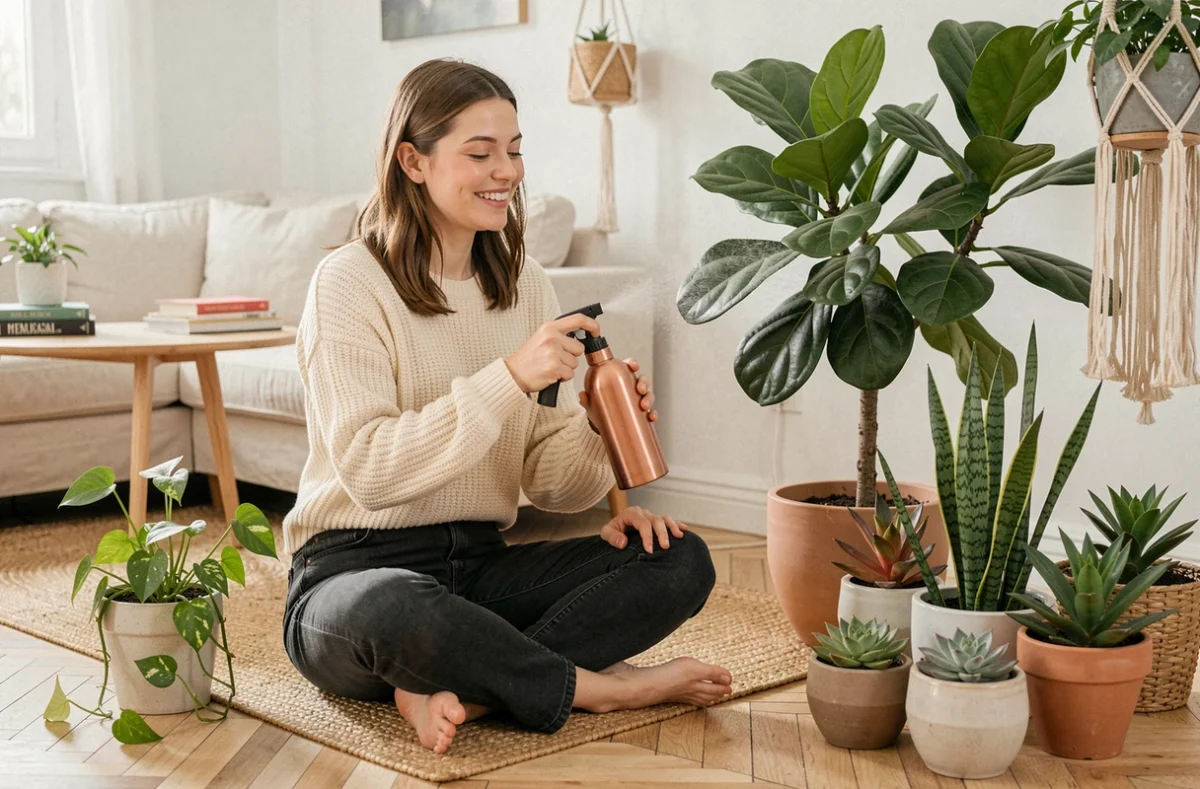
Indoor plants often die from overwatering rather than from a lack of it. Watering according to a fixed schedule is the primary cause of root rot in potted plants. The frequency of watering depends on light levels, ambient temperature, pot volume, and the species being grown.
A simple method: stick a finger into the substrate two centimeters deep. If the soil is still moist, postpone watering. This tactile check replaces all theoretical schedules.
In autumn and winter, indoor plant growth slows down. Reducing watering and suspending fertilizer applications during this period prevents the accumulation of mineral salts in the substrate, a problem that manifests as whitish deposits on the surface and burned leaf tips.
The most reliable gardening tips are those that take real constraints into account, whether it concerns water regulations, the legal framework for treatment products, or simply the nature of your soil. A well-maintained garden starts with checks, not with ready-made recipes.