At two months, a puppy’s bladder only allows for very brief holding. Teaching a 2-month-old puppy to be clean relies less on the mechanical repetition of outings and more on understanding its actual physiological capabilities and finely managing its environment. Here we detail the technical levers that accelerate this learning without generating behavioral confusion.
Elimination Surface and Transfer to the Outside
A rarely addressed point in popular guides: the substrate on which the puppy eliminates shapes its future preferences. A puppy accustomed to absorbent mats may later refuse grass, gravel, or concrete. This blockage is common and complicates the transition to the outside.
We recommend a gradual method. First, place the absorbent mat near the exit door, then move it outside. Gradually reduce its size over several days until the puppy accepts eliminating directly on the ground. This transition avoids creating a dependency on the mat that delays cleanliness for a puppy by several weeks.
If you live in an apartment and frequent outings are difficult, vary the textures from the start: place the mat on a different surface each day (tile, synthetic grass, small square of natural grass in a container). The puppy learns that the location matters less than the signal to go out, which simplifies house training. For more in-depth information, practical tips on British & Co detail this method step by step.
Puppy Training Crate: Physiological and Emotional Limits
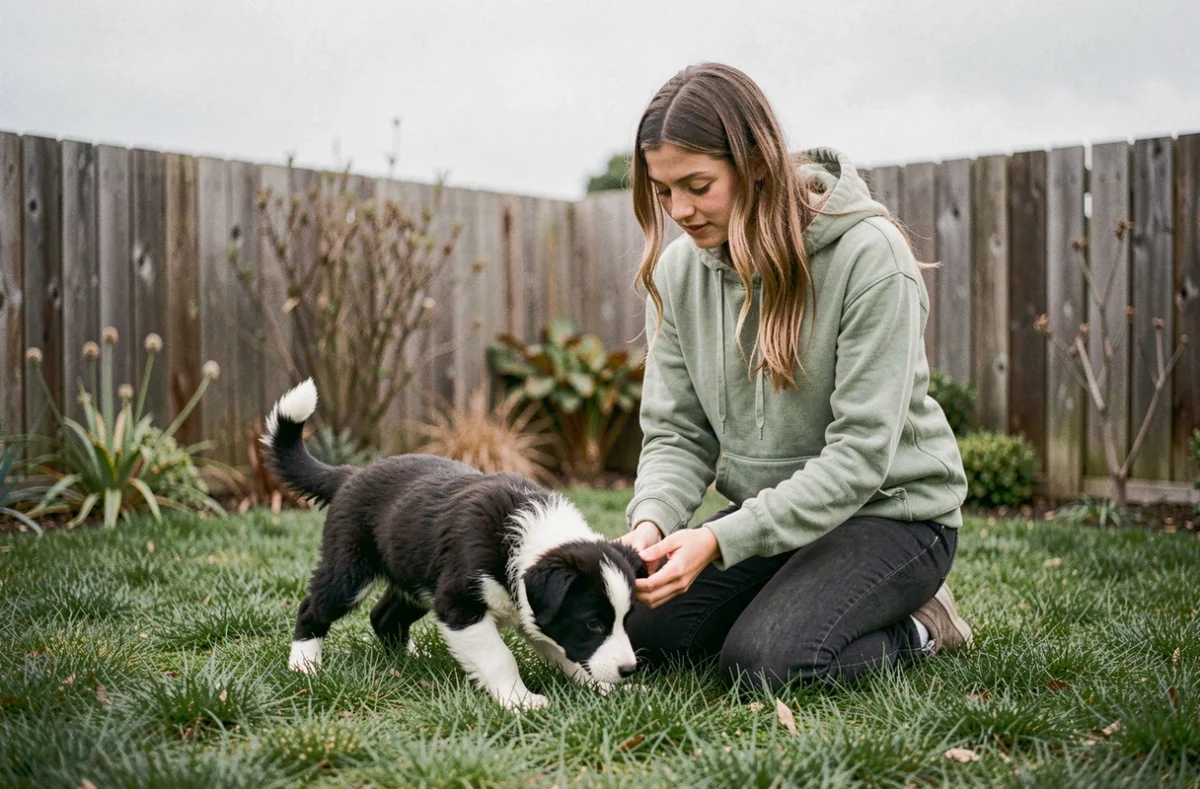
The crate is an effective house training tool, provided the puppy’s actual capabilities are respected. Never confine a puppy longer than it can hold. At two months, this duration is very short, around one to two hours during the day.
The American Kennel Club emphasizes a point we consider non-negotiable: if the crate triggers panic or evident distress (continuous vocalizations, attempts to escape, immediate elimination), it is necessary to stop and reassess the approach. The crate should never serve as a mere retention tool.
Progressive Introduction Protocol
- Leave the crate open with a blanket and a chew toy for several days before closing the door. The puppy should enter on its own.
- Close the door for a few minutes while the puppy is calm and satisfied, then open it before any signs of stress. Gradually increase the duration in five-minute increments.
- Never place the crate in an isolated room. The puppy should see or hear household members to associate this space with safety, not punishment.
- Take the puppy out immediately after each crate period. This crate-outside-reward sequence builds the elimination reflex outside.
A well-used crate speeds up cleanliness; a poorly used one creates anxiety that increases the frequency of accidents in the house.
Outing Rhythm and Elimination Signals in a 2-Month-Old Puppy
The pre-elimination behavior of a puppy is stereotyped but quick. It circles around, sniffs the ground insistently, and squats slightly. The time between the first signal and elimination is counted in seconds. We observe that most accidents occur not due to a lack of outings but because the owner misses these signals.
Instead of taking the puppy out rigidly every hour, align outings with risky physiological moments:
- Immediately upon waking (from a nap or night), without going through a play phase inside.
- Within five to ten minutes after each meal. A fixed feeding schedule makes needs predictable.
- After each play or excitement session, as physical activity stimulates transit.
- Just before crating or bedtime.
Fixed meal times produce fixed needs, which greatly simplifies learning. Free-feeding is one of the most counterproductive mistakes at this age.
Positive Reinforcement and Managing Indoor Accidents
The reward must occur within two seconds following elimination outside. A treat given thirty seconds later, once back in the house, reinforces the behavior of coming inside, not that of eliminating outside. The timing of reinforcement matters more than the nature of the reward.
In case of an accident indoors, any form of punishment is counterproductive. A two-month-old puppy cannot make the connection between a correction and a past act, even if it was just a few minutes ago. We find that punished puppies often develop hidden elimination behavior (behind furniture, in another room), which further complicates training.
Cleaning and Odor Neutralization
Cleaning up accidents directly conditions recurrences in the same spot. Ammonia and bleach should be avoided: their smell, similar to that of urine for the puppy, attracts rather than deters. Use an enzymatic cleaner that breaks down urinary proteins instead of simply masking the odor.
An accident cleaned with the wrong product remains an active olfactory marker for the puppy, even if you no longer smell anything.
Early Outings and Puppy Socialization Before Vaccination Completion
The fear of diseases leads some owners to confine the puppy until the end of the vaccination protocol. Recent recommendations nuance this approach. Socialization should not wait until the end of vaccinations, but outings must be controlled: puppy carried in public places, clean environment, limited contact with healthy, vaccinated adult dogs.
Avoid areas with high concentrations of waste and stagnant water. This early and cautious exposure allows the puppy to associate the outside with a normal and positive space, which facilitates house training alongside socialization.
House training a two-month-old puppy relies on three technical pillars: managing the elimination substrate, respecting its retention limits, and precisely timed positive reinforcement. Systematic enzymatic cleaning and fixed meal times complete the setup. Each day of consistency reduces the time before complete cleanliness.