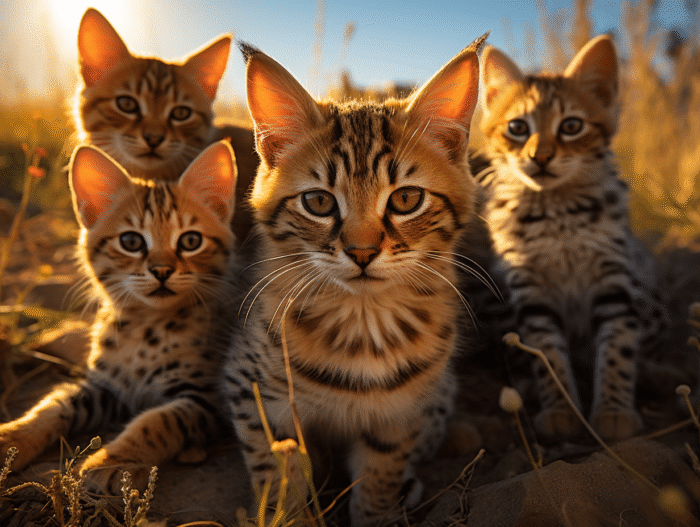
Felines, graceful and mysterious creatures, showcase a diversity of coats in varied shades, from striking stripes to solid hues, including subtle marbling. Each species, and even each individual, possesses a distinctive palette, the result of evolution shaped by environmental and genetic factors. These chromatic variations are not mere whims of nature; they play a fundamental role in the survival and social behavior of felines. The study of these shades reveals fascinating adaptations and highlights the extraordinary ability of these animals to blend into their environment or, conversely, to stand out.
The Color Shades in Felines: Diversity and Adaptation
In the world of felines, the spectrum of colors is as broad as the variety of species. Colors in felines are not limited to the classic black, white, or red, but extend to tortoiseshell, tabby, or distinct patterns like those of the Bengal cat. The diversity of coat colors and eye colors in felines results from a meticulous adaptation to their environment, as well as a complex evolutionary history that has shaped each breed of cat.
Cats’ visual perception, which has a wider field than that of humans, directs them towards certain shades of blue and green that they distinguish with superior clarity. Cats have difficulty recognizing shades of red and pink, colors that are often absent from their coats. These visual peculiarities, combined with their crepuscular nature, influence the evolutionary choices regarding the color of their fur.
Domestic cats, for their part, present an even broader range of colors and patterns. A cream cat or a tricolor cat are just two examples among many possibilities. These variations are not merely aesthetic; they can also indicate certain genetic traits, as is the case for cats carrying the tortoiseshell gene, often associated with femininity due to its sex-linked genetic transmission. The colors and patterns are not just visual characteristics. They reflect a deep adaptation and a biological significance that transcends mere appearance. The color shades in felines and their peculiarities mirror a world where vision, survival, and social behavior are intimately linked to genetics and evolution.

Genetic and Functional Particularities of Feline Colors
The perception of colors in cats is a field where science debunks myths. Contrary to popular belief, felines do not rely on a monochrome universe. Their color vision, although different from that of humans, is adapted to their predatory needs. The tapetum lucidum, this reflective layer behind the retina, gives them remarkable night vision, far surpassing that of humans. This adaptation is an asset in nighttime hunting, when most cats are most active.
Genetics plays a key role in the range of colors and patterns observed in cats. The color of the coat is determined by genes that modify the type and distribution of melanin. For example, the gene responsible for black color can be altered to produce shades of chocolate or cinnamon. Similarly, specific mutations are responsible for unique patterns, such as those of the Bengal cat, which features rosettes reminiscent of those of leopards.
The paws and the nose of cats also reflect the underlying genetics of their coat color. Black cats often have black paw pads, while felines with lighter coats have pink or a shade corresponding to their fur. These details, though subtle, outline the contours of a complex genetic mapping, where each color detail is the expression of a specific hereditary story.
Domestic cats, with their vast array of colors and patterns, are the product of both natural and human selection. Breeds like the Maine Coon or the tricolor cat illustrate the diversity resulting from this selection. Cat toys, by exploiting shades of blue and green, take advantage of this particular feline perception. Manufacturers design products that capture the attention of felines, incorporating bright hues and contrasting patterns, thus leveraging the specific visual characteristics of these animals.